
Home page...

2009 Moon Phases & Lunar Moon Calendar

2009 Moon Phases

We have 2009 Moon Phases & Lunar Moon Calendar here at KeepandShare, ready for you. Looking for online moon phases or full moon websites? Or perhaps phases of the moon for work or family full moon?

Lunar phase refers to the regular appearance of the illuminated portion of the Moon as seen by an person, usually on Earth. The lunar phases vary as the Moon orbits the Earth, according to the changing geometry of the Earth, Moon, and Sun. One half of the lunar surface is always illuminated by the Sun (except during lunar eclipses), and is hence bright, but the portion of the illuminated hemisphere that is visible to an observer can vary from 100% (full moon) to 0% (new moon). The boundary between the illuminated and unilluminated hemispheres is called by a cool name, 'the terminator.'

Click on one of the above links to go directly to your 2009 Moon Phases.

Lunar phases are the result of our eyes seeing the illuminated half of the Moon from different viewing geometries: they are not caused by shadows of the Earth on the Moon that occur during a lunar eclipse. The Moon exhibits different phases as the relative geometry of the Sun, Earth, and Moon change, appearing as a full moon when the Sun and Moon are on opposite sides of the Earth, and as a new moon (also named dark moon) it is not visible at night when they are on the same side.

The phases of full moon and new moon are examples of syzygies, which occur when the Earth, Moon, and Sun lie (approximately) in a straight line. The time between two full moons (or between successive occurrences of the same phase) is about 29.53 days (29 days, 12 hours, 44 minutes) on average. This synodic month is longer than the time it takes the Moon to make one orbit about the Earth with respect to the fixed stars (the sidereal month), which is about 27.32 days. This difference is caused by the fact that the Earth-Moon system is orbiting about the Sun at the same time the Moon is orbiting about the Earth. The actual time between two syzygies is variable because the orbit of the Moon is elliptic and subject to various periodic perturbations, which change the velocity of the Moon. (Source: from Wikipedia)

Meanwhile, consider joining KeepandShare - it's a free online service for sharing calendars, files, moon phases schedual 2008 lunar phase and more. Use your free account to bring others closer to you by sharing online, so why not read three key benefits of KeepandShare now:

Try Your Own Account

KeepandShare is the ideal way to securely share calendars, photos and files. It's a private sharing space where you and your friends or colleagues can easily and privately share calendars, files, photos & more - you always control exactly who can see what.

Sign Up Now


With Your Free Account You'll Have:

  1. A free, online file, photo & calendar sharing site on the web
  2. Selective sharing, secure for only those you want to share with
  3. No software to install
Click the links below to learn more about KeepandShare.

  • As easy-to-use as a wall calendar: just click and type!
  • Keep your schedule online: accessible from any computer
  • Securely share your calendar: they'll always see the up-to-date version
  • Up to nine separate calendars
  • Beautifully formatted PDF printing
  • Unlimited text in each day
  • Day, week & month views include repeating events and flexible calendar overlays

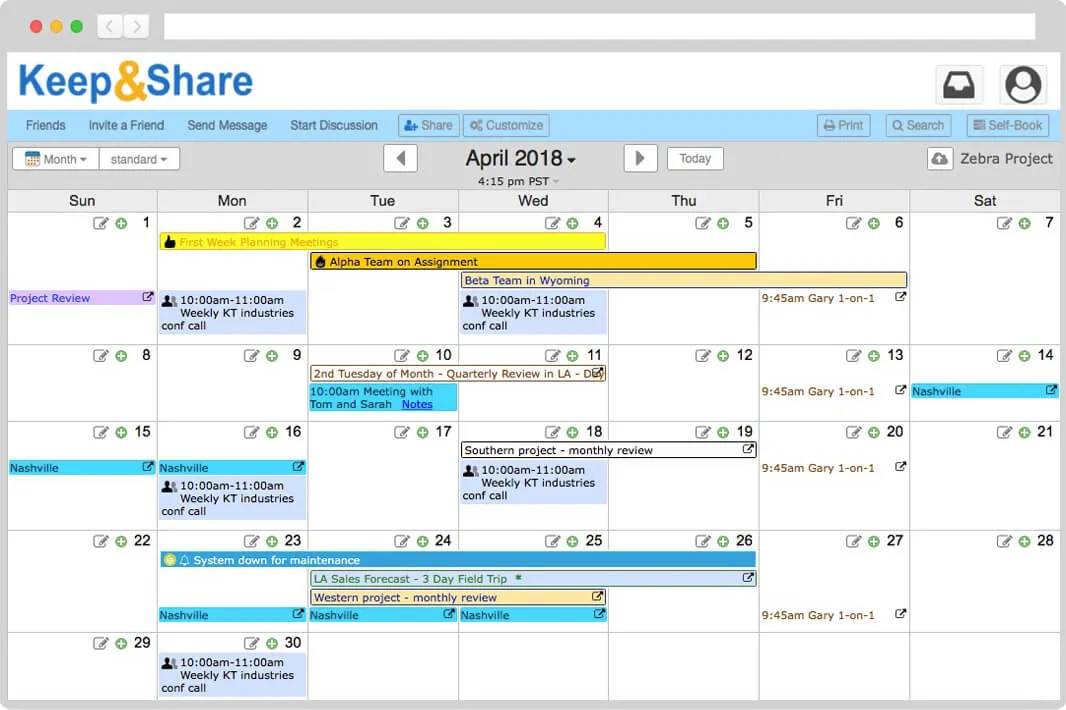
Keeping your calendar up-to-date and your family or group in-synch has never been easier. Use online KeepandShare calendars for each area of your life - one calendar for work, one for home, one for your kid's school schedule.

Every calendar is privately sharable with just those you want to see it. Since the calendars allow unlimited text in each day box, they are ideal for easily noting down details on your day's tasks, meetings or keeping a journal.

  • Never lose files in email again
  • Upload any kind of PC file: spreadsheets, word processing, PDFs, MP3, video, powerpoints... anything!
  • Store 1000's of files neatly organized in folders
  • Link back to your files from your blog or webpage
  • Single-click downloading to any PC or Mac

Upload your files just by pointing and clicking in an easy-to-use bulk file uploader.

Easily share files on the world-wide-web, controlling just who sees what.

Access your stored files from any internet connected PC, whether from work or home. You and your friends can easily download files with single click downloading. And you can always track all activity by clicking the 'history' button for a report on all views and downloads of each file.

  • Upload gorgeous, high resolution photos with a friendly bulk-uploader
  • Edit & tag your photos, and add virtually unlimited text with rich formatting
  • Create online albums with 5 viewing styles
  • Share albums online with safe and easy group sharing
  • Search photos by keyword, tag & date
  • Your friends can view & download your photos in extremely high resolution
  • Link to your photos from your blog or website

Upload and organize all your photos in 1800 pixel resolution - enough to fill the largest computer screen. Each photo can have unlimited text descriptions and you can easily organize and search your photos with 'tags'.

Easily place your photos into online albums that can be viewed in five powerful album styles. And, of course, your albums come with all of the benefits of KeepandShare's safe and easy group sharing, so each album can be either publicly or privately shared.

  • Easy-to-use to do lists with free-format text entry are easily sorted by priority and due date
  • Web-based bookmarks can be shared and accessed by all group members
  • The address book allows unlimited text & fonts for extensive notetaking on each address entry
  • Secure, private discussion areas organize your group's comments

You'll find KeepnadShare is a consistently easy-to-use set of web applications, because they all work exactly the same.

Besides the main calendar, file sharing & photo applications, your free account also builds in a suite of all the web functionality you and your group will need - bookmarks, to do lists, addresses, and discussion areas.

What do I get for my money?

Didn't we tell you KeepandShare is free? We can offer a life-time free account because KeepandShare is advertising supported. We hope you agree free accounts are very capable, with an unlimited number of documents, 9 calendars, 100mb of free uploaded files, and very high resolution photo uploads.

Solely at your option, you can choose to pay a very modest subscription fee to upgrade your account. Upgraded accounts are ad-free and have enhanced capacity and features.

Click here for details on free and paid membership plans

We also recommend 2008 Calendar, 2010 Calendar Template, 2011 Calendar Template, 2012 Calendar Template, 2013 Calendar Template, 2014 Calendar Template, 2015 Calendar Template, Blank Calendar, Business Calendar, Calendar.com, Calendar Maker, calendar printing, Calendar Software, Calendar Template, Free Downloadable Calendar, When is Easter, Family Calendar, Free Printable 2007 Calendars With Holidays, 2009 Calendar Template, Monthly Calendar, Office Calendar, Online Calendar, Free Photo Calendar, Printable Calendar, Web Calendar, Weekly Calendar, Yearly Calendar, 2009-2010 Calendar Template,

Recent News:

02/08/2010 3-2-1 Launch... Only 4 To Go!

The Space Shuttle Endeavour left the launch pad early this morning and is now in orbit on its way to the International Space Station (ISS). This is the first shuttle flight of the year, and represents the beginning of the end for the aging shuttle fleet.

The focus of this mission is to deliver a module to the ISS that will increase the interior space and provide additional living quarters. While the crew will not arrive to the space station until Wednesday, they are busy testing equipment and preparing for the space walks that will be needed to install the new node and research facility.

Image Credit: NASA

3-2-1 Launch... Only 4 To Go! originally appeared on About.com Space / Astronomy on Monday, February 8th, 2010 at 22:56:08.

Permalink | Comment | Email this

02/04/2010 Update on NASA Budget

Last week I noted that the Obama administration had cut the Constellation Program from the budget, effectively killing the proposed return mission to the Moon and future manned Mars missions. An ancillary effect being that we would not need to rely on our Russian counterparts to complete our obligations to the International Space Station. This news initially angered proponents of the space program, including myself, because of the administration's demolition of our manned space program.

However, once President Obama officially released the complete budget and vision for the future of our space program things began to come into focus. The Constellation Program was behind schedule and over budget. It may turn out to be that canceling the program is the best long term solution. However, this does mean that we will effectively outsourcing our manned space program for the next several years at least.

There is another side to the story however, one that I overlooked in my haste to criticize the extermination of the Constellation Program. The government is actually getting behind NASA and the space program. President Obama has committed $6 billion more to NASA's budget over the next five years than expected. The new focus is going to be on developing new technologies to advance our ability to do space research as well as lower future costs of space exploration. And, while the Constellation Program is dead, the future of manned space exploration is not.

The president is laying the ground work for what NASA calls "A bold new effort that invests in American ingenuity for developing more capable and innovative technologies for future space exploration". This exploration will also rely more heavily on private industry and other nations to develop new technology and take on some of the manufacturing burden for large scale projects. It may be slow going -- forget about the 2020 and 2030 time tables for landing men on other worlds -- but this new program promises to be better and more cost effective in the long run.

The International Space Station (ISS) will also see its life extended, at least through 2020. This will allow the ISS to reach its full potential.

So, I must admit, I may have been too quick to judge. After looking more deeply at the plan that has been laid out for NASA, I think we are heading in the right direction, it will just take some time to see it through to fruition. The new plan is immense and complex, and I will outline the details in a forthcoming article, but until then I just want to make clear that there is a future for the space program. And the details of that program are beginning to come sharply into focus. Stay tuned.

Image Credit: NASA

Update on NASA Budget originally appeared on About.com Space / Astronomy on Thursday, February 4th, 2010 at 14:22:06.

Permalink | Comment | Email this

02/03/2010 The Future of the International Space Station

As part of the re-invisioning of NASA (more on this tomorrow), the work of the International Space Station will be extended through at least 2020. This will allow scientists to expand the experiments being conducted and, according to NASA, enable "this vital orbiting laboratory to reach its full potential."

Sounds good to me. Personally though, I was just psyched about this image that was released along with the announcement. Pretty spectacular, huh? Telll me what you think!

Image Credit: NASA

The Future of the International Space Station originally appeared on About.com Space / Astronomy on Wednesday, February 3rd, 2010 at 15:29:36.

Permalink | Comment | Email this

02/01/2010 NASA Has Given Up on Getting Spirit Free

NASA has announced that it has officially given up trying to free the Spirit Rover from the bed of sand that has been holding it captive. (For a rather funny portrayal of these events, go here.) This does not mean however that it will no longer provide scientific data. Rather, it will study the surrounding martian surface and what lay beneath it.

The coming Martian winter is of concern, but NASA hopes that the little trooper will survive. Should the rover live on, scientists hope that it can help answer a question that has plagued them for years: is the Martian core completely solid, or does it contain a liquid outer shell like Earth?

So, it's not a particularly sexy question, but it is of considerable importance. You see, the origin of our solar system is still something of a mystery. The solar nebula hypothesis -- the theory that our solar system evolved from a large cloud of gas and dust -- has gone a long way in explaining the data we have collected about our solar system. However, as we have begun to study other solar systems we have noticed that they have significantly different characteristics than our own. So, at the very least, assumptions that we made about the origin and evolution of our solar system don't seem to apply to solar systems in general.

The hope is that the more that we study other worlds we can get a clearer picture of how our solar system formed, and perhaps shed some light on a rather significant hole in our scientific understanding.

Image Credit: NASA

NASA Has Given Up on Getting Spirit Free originally appeared on About.com Space / Astronomy on Monday, February 1st, 2010 at 17:04:53.

Permalink | Comment | Email this

01/29/2010 Amazing Full Moon in Store Tonight

Those of you lucky enough to be around clear skies tonight -- I live in the midwest so I haven't seen a clear sky for weeks -- then check out the Moon. It is only the end of January, but the Moon will be on its closest approach of 2010, making it appear bigger and brighter than it will ever appear again this year.

For simplicity we usually discuss the orbit around the Earth as having a circular path, but in fact it is slightly elliptical. Tonight, the Moon will be more than 15,000 miles closer to Earth than average, making it appear about 30% larger and brighter.

You should be able to see good detail, even with the naked eye. If you live near an observatory though, you might want to consider venturing out to see some of the cool features on the surface.

Image Credit: NASA/JPL/USGS

Amazing Full Moon in Store Tonight originally appeared on About.com Space / Astronomy on Friday, January 29th, 2010 at 14:23:43.

Permalink | Comment | Email this

Your 2009 Moon Phases Resource Center:
   Choose from the Links Below

Popular Websites for 2009 Moon Phases & Lunar Moon Calendar

We've researched the web and found some of the most popular sites on Lunar Moon Calendar and 2009 Moon Phases. Here they are!

2009 Moon Phases
Moon Phases
Full Moon
New Moon
Lunar Calendar
Full Moon Schedule
8 Phases Of The Moon
Lunar Moon Calendar
Phases of the Moon
Moon Schedule
Moon Phases Calendar
Full Moon Calendar
Full Moon Dates

Consider some of our other pages including free monthley calender oficio calander as well as free calender 2008 calander templet photo calendar in addition to free printable calander web callander.

The Moon exhibits different phases as the relative geometry of the Sun, Earth, and Moon change, appearing as a full moon when the Sun and Moon are on opposite sides of the Earth, and as a new moon (also named dark moon) it is not visible at night when they are on the same side. Lunar phases are the result of our eyes seeing the illuminated half of the Moon from different viewing geometries: they are not caused by shadows of the Earth on the Moon that occur during a lunar eclipse. If you are looking for 2009 moon Phases or 2009 moon Phases you've come to the right place for 2009 Moon Phases. The phases of full moon and new moon are examples of syzygies, which occur when the Earth, Moon, and Sun lie (approximately) in a straight line. One half of the lunar surface is always illuminated by the Sun (except during lunar eclipses), and is hence bright, but the portion of the illuminated hemisphere that is visible to an observer can vary from 100% (full moon) to 0% (new moon).

The actual time between two syzygies is variable because the orbit of the Moon is elliptic and subject to various periodic perturbations, which change the velocity of the Moon. Monthly 2009 Moon Phases is important with this year Moon Phases fast 2009 with Moon web and website online resources. The time between two full moons (or between successive occurrences of the same phase) is about 29. The boundary between the illuminated and unilluminated hemispheres is called by a cool name, 'the terminator.'

Use website tools such as 2009 Moon phases or 2009 Moon phases for online 2009 Phases efficiency gains. Lunar phase refers to the regular appearance of the illuminated portion of the Moon as seen by an person, usually on Earth. If you are looking for 2009 moon Phases or 2009 Phases moon you've come to the right place for Phases moon 2009. The lunar phases vary as the Moon orbits the Earth, according to the changing geometry of the Earth, Moon, and Sun. 32 days. 53 days (29 days, 12 hours, 44 minutes) on average.

Like this page?

Tell a Friend URL: